How to organize your music career when it lives in a group chat, three spreadsheets and somebody's memory: the case for a real system, the best case against one, and the smallest setup that works.
It is 5:40 on a Saturday and load-in was at five. The drummer is in the parking lot asking the group chat which door. The artist is texting her manager to ask whether the guest list reached the venue. Her manager, at another show, has no idea, because the list lives in a note on the guitarist's phone and the guitarist is driving.
Nobody in that scene is lazy. If you have lived some version of that night, you already know the question this piece answers: how to organize your music career so the work you already do stops leaking out of it.
The show starts twenty minutes late. Two friends wait outside. The merch count at midnight does not match the box count from the morning, because nobody wrote the box count down. My answer to all of it is less about software than you might expect from a blog run by a company that builds some, and it starts with an argument.
Scattered tools cost you decisions, not minutes
The usual complaint about a disorganized career is time: hours lost hunting for a file, retyping a bio, rebuilding a budget from bank statements. That cost is real, but it is the cheap one.
The expensive one is the decision made without information that existed somewhere. You book a second night in a city because the first one felt full, while the ticket report that said otherwise sits in a promoter's inbox. You put the ad money behind the single your own streaming numbers had already quietly ruled out. You agree to a feature nobody could check against the release calendar, because nobody could find the release calendar.
Most teams have the data. What they lack is the data in the same room as the decision. When the release plan is in one document, the money is in a spreadsheet, the contacts are spread over three inboxes and the show logistics are in a chat, every choice gets made by whoever happens to be holding the relevant piece. It is a relay race where nobody is sure who has the baton.
Plenty of the mistakes independent artists make trace back to exactly this. The instincts were fine. They were running without the numbers that would have corrected them.
The best case for staying on spreadsheets
Here is the strongest argument against everything above, and it deserves its full weight, because a version of it is right.
Spreadsheets are free. Everyone on your team already knows how to use one. They bend to whatever you need, their price never changes, and they never lock your information inside somebody else's product. Careers have been run for years on a shared drive, a calendar and discipline. And plenty of artists who get organized by buying a tool simply end up with a second place to be disorganized, plus a monthly bill.
All of that is true. If you are a solo artist putting out a few songs a year, with no team, no shows and no budget beyond your own card, a well kept spreadsheet may be all you ever need. Nobody, me included, should talk you out of it.
Where the spreadsheet breaks
The spreadsheet rarely fails on day one. It fails the first time a second person has to change it.
Add a manager, a bandmate, a publicist or someone at a label and you get versions: "Budget FINAL v3" and "Budget FINAL v3 (Marco's edits)". Nobody is sure which tab is current. Tasks get assigned in the chat and tracked in the sheet, which means they are tracked nowhere. The calendar says the release is on the 14th, the distributor says the 21st, and somebody worked out the pitch deadline from the wrong one.
The other failure is quieter. A spreadsheet only knows what someone typed into it. It cannot warn you that a pitch window closes in nine days, or that next month's show is running over budget, unless a person remembers to look. Organization that depends on memory is not organization. It is a good week.
So the useful test has nothing to do with software. Ask whether your setup still holds when more than one person is involved and nobody remembers to check it.
How to organize your music career: the verdict
Build the smallest system that passes that test, and add software only when the system outgrows what you can keep up by hand. The minimum has five parts.
One calendar for every date. Releases, pitch deadlines, shows, content drops and payment dates all live on a single calendar the whole team can see. A date recorded anywhere else does not exist.
One ledger for money in and money out, updated when the money moves rather than rebuilt at tax time.
One folder for the things people ask you for: the bio, the photos, the press quotes, the stage plot, the logos. Named clearly enough that a stranger could find them.
One owner for every task. Not "the team". A name and a due date.
And one standing check-in each week: twenty minutes where someone reads the calendar, the money and the open tasks out loud. It is the part everyone skips, and it is the part that makes the other four work.
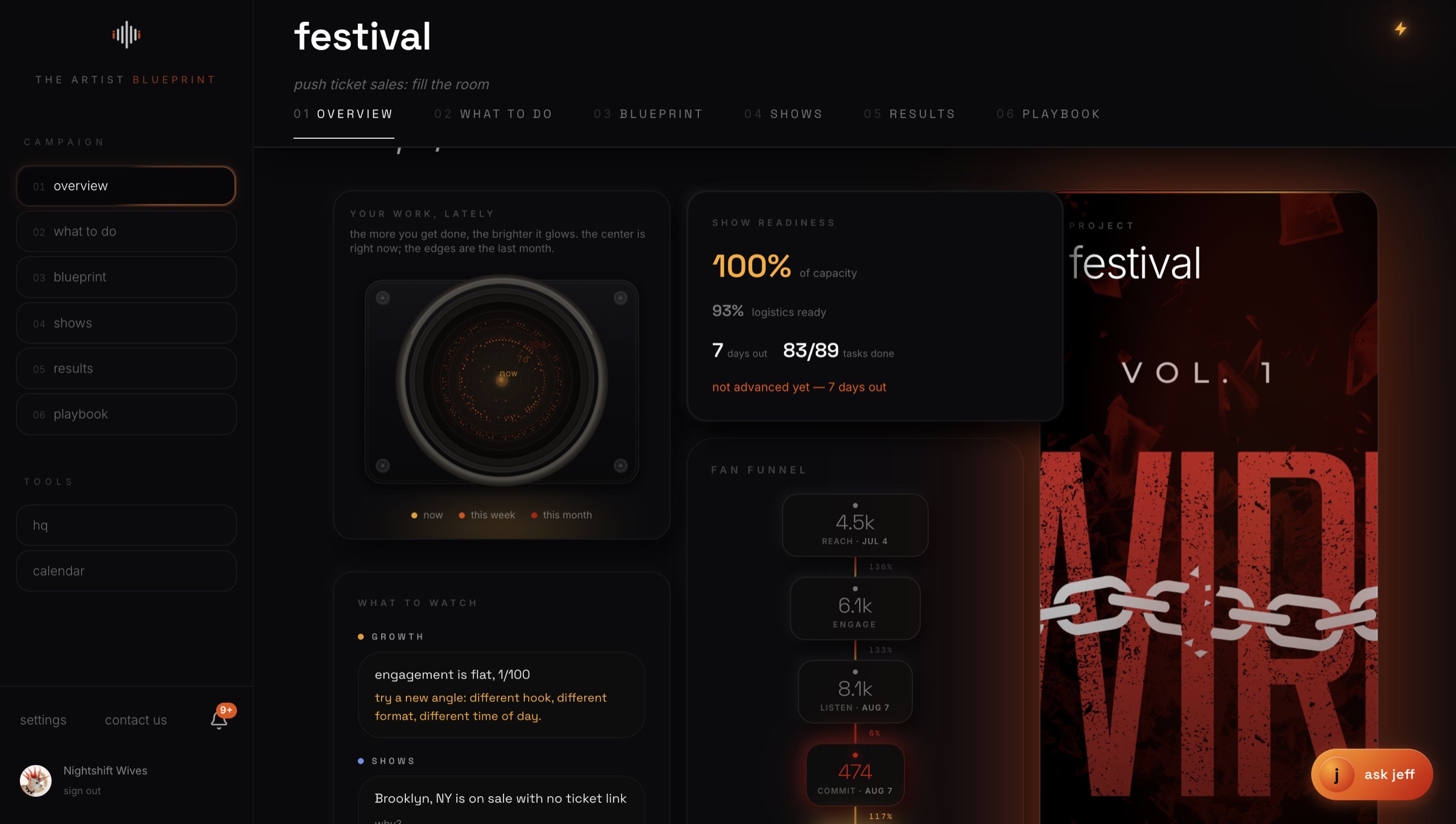
If you can run all five on a shared drive, do that. When you can't, because the team has grown, the releases overlap or the shows have started, a platform built for the job starts earning its keep. That moment is what we built The Artist Blueprint for, and the story of why we built it opens on scenes a lot like the parking lot above. Reach for it when your system outgrows the spreadsheet, not before.
Either way, 5:40 in the parking lot is optional. Somebody just has to decide where the door information lives, and put it there.
Read next: Inside The Artist Blueprint →
Making music worth hearing? Submit your music →
Working on something bigger than one release?
We build and run campaigns for artists and brands — testing a single, rolling out an album, taking a tour global. Same team from brief to launch.
Comments